
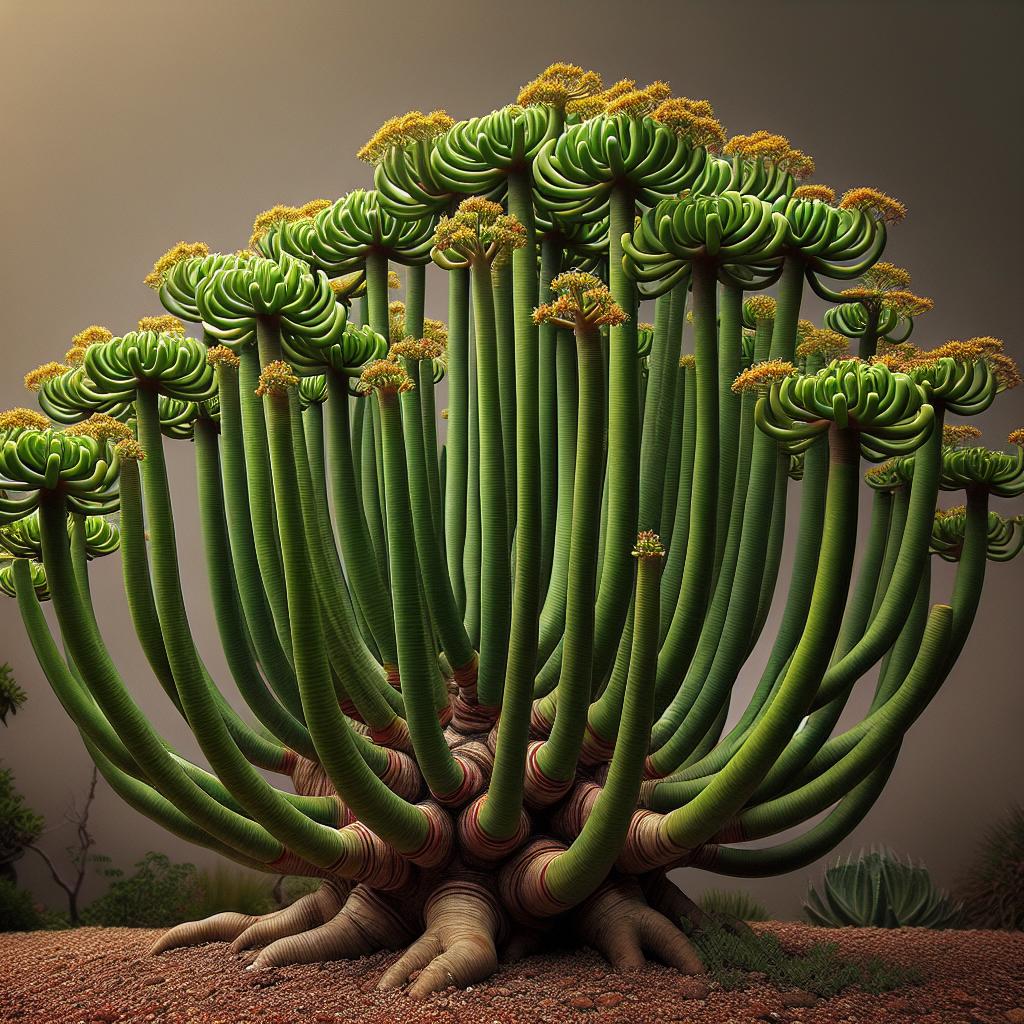
About Euphorbia tirucalli
### Euphorbia tirucalli (Indian Tree Spurge) #### Safety Information for Pets **Toxicity**: Euphorbia tirucalli is highly toxic to pets, including cats, dogs, and other small animals. The plant contains a milky latex sap that can cause severe irritation upon contact. If ingested, it can lead to symptoms such as drooling, vomiting, diarrhea, abdominal pain, and lethargy. Contact with the skin or eyes can result in redness, swelling, and severe irritation. In severe cases, ingestion can lead to more serious health issues requiring immediate veterinary attention. It is advisable to keep this plant out of reach of pets. ### General Description **Scientific Name**: Euphorbia tirucalli **Common Names**: Indian tree spurge, milkbush, fingertree, penciltree, gummieuforbia, African milkbush, milkhedge, aveloz, eufórbia, Tohifafa hazo, consuelda, Latex-Wolfsmilch, euphorbe antivenerien, naked-lady, Indiantree Spurge, Bois de lait, Indiantree spurge, almeidinha. **Family**: Euphorbiaceae **Plant Type**: Succulent shrub #### Origin and Habitat Euphorbia tirucalli is native to tropical and subtropical regions of Africa and India. It thrives in arid environments and is often found in dry, rocky soils. The plant is well-adapted to withstand drought conditions and can be found growing in both wild and cultivated environments. #### Physical Characteristics - **Size**: This plant can grow to a height of 4-12 meters (13-39 feet) in its natural habitat, although it typically remains smaller when grown as a houseplant. - **Stems**: The plant has slender, cylindrical, and smooth green stems that resemble pencils, hence the common name "penciltree." These stems are often devoid of leaves, giving the plant a stark, almost skeletal appearance. - **Leaves**: When present, the leaves are small, narrow, and short-lived, quickly falling off to leave the green stems exposed. - **Flowers**: Euphorbia tirucalli produces small, inconspicuous yellow flowers. These flowers are generally not the primary attraction of the plant and may go unnoticed. - **Latex**: The plant’s milky sap is highly toxic and can cause severe irritation to the skin and eyes. Handle with care and wear gloves when pruning or propagating. #### Cultivation and Care - **Light**: Prefers full sun to partial shade. It requires bright, indirect light if grown indoors. - **Soil**: Thrives in well-draining soil, such as sandy or cactus mix. Avoid waterlogged conditions, which can lead to root rot. - **Watering**: Water sparingly. Allow the soil to dry out completely between waterings. Overwatering can be fatal to the plant. - **Temperature**: Prefers warm temperatures and is not frost-tolerant. Ideal temperature range is 18-27°C (65-80°F). - **Fertilization**: Fertilize sparingly, if at all. Use a balanced, diluted fertilizer during the growing season. #### Uses and Benefits - **Ornamental**: Often used as an ornamental plant in gardens and landscapes, particularly in xeriscaping and rock gardens. - **Traditional Medicine**: In some cultures, Euphorbia tirucalli has been used in traditional medicine for various ailments. However, due to its toxicity, such uses are not recommended without professional guidance. - **Industrial**: The latex has been explored for potential use in biofuel production and rubber substitutes. #### Propagation Euphorbia tirucalli can be propagated through stem cuttings. Allow the cuttings to dry and callous over for a few days before planting in well-draining soil. Ensure that cuttings are taken with caution due to the toxic sap. #### Caution Due to its toxicity, Euphorbia tirucalli should be handled with care. Always wear gloves and protective eyewear when handling the plant to avoid contact with the sap. Keep the plant out of reach of children and pets. ### Conclusion Euphorbia tirucalli is a striking and hardy plant that can add visual interest to gardens and indoor spaces. However, its toxicity requires careful handling and consideration, particularly in households with pets and children.